
Wall Street loves to create moneymaking gods for public worship. Sometimes those gods deserve adulation, and sometimes they do not. Discovering who is deserving and who is not is what makes the TurtleTrader story so compelling. By the time Michael Covel’s research was over, a story had been assembled that some TurtleTraders would want deciphered and disseminated, while others would work hard to bury with all the secrecy of a Cold War-era CIA operation.
This page pulls back the curtain on the myths, the contradictions, the behind-the-scenes drama, and the characters that no Hollywood scriptwriter could have invented. It is the story behind the TurtleTrader story.
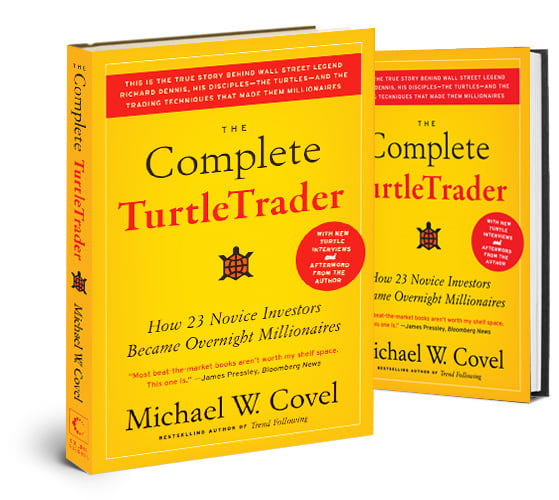
Opening up the blinds and letting sunshine in could only help investors without TurtleTrader-like access and success to realise that the TurtleTraders were human. If the original TurtleTraders could learn, the ones chosen off the street, anyone could. Yes, the trading rules they were taught were critical, and yes, some were very intelligent, but the human element cannot be ignored when analysing the experiment’s results from 1983 to 2008. After much internal debate, it was clear that an Afterword was needed for the paperback version of The Complete TurtleTrader.
Digging down into the TurtleTrader vault was like entering the matrix, filled with unexpected twists and turns that even the best Hollywood scriptwriters could not have dreamed up. It was like a marathon session of Nintendo’s Mario Brothers 3 when you enter new worlds where secret clues and hidden meanings pop up each step of the way, but only if you are willing to venture into uncharted territory where there are no guarantees that your risk will pan out.
The Investigation Begins: New TurtleTraders Nobody Had Heard Of
That said, while investigating the TurtleTrader story it seemed attitudes had finally changed and TurtleTrader openness was in vogue. One TurtleTrader said he would be happy to do an interview “by phone if necessary.” Another said that he would be happy to discuss the TurtleTrader experience. Another TurtleTrader only wanted to provide written answers to questions, but at least he was talking. Yet another said he would not mind if the circumstances were right. Ultimately those responses resulted in thoughtful and incisive interviews.
As research gained steam, a new TurtleTrader nobody had heard of appeared. There was Rudolf Papirnik. Robert Moss, Dennis’s trading-floor chief, called Papirnik a TurtleTrader. Papirnik worked for Dennis before, during, and after the TurtleTrader program. A known TurtleTrader, Jim DiMaria, backed Moss’s contention that Papirnik was a TurtleTrader too.
Moreover, once the TurtleTraders started talking they were quick to express concern that Dennis would be portrayed as their primary if not only teacher. They did not want anyone to diminish the importance of Bill Eckhardt to their success. Take Jeff Gordon who was emphatic:
“Bill [Eckhardt]. Very smart guy. It seemed like every time he spoke, I learned something. And there are very few people in the world that I have ever met that I can say that about. I was always learning things from him.”
Time and time again, TurtleTraders kept coming back to the importance of Bill Eckhardt’s teachings.
Besides properly crediting Eckhardt, several TurtleTraders gave different versions of the genesis of the original “Turtle” nickname. Mike Shannon contradicted the legend that Dennis named his students after seeing a turtle-breeding farm in Singapore: “Our original name, in the first year of our existence, was the Disciples. Because it was the name, at the time, of a prominent street gang on Chicago’s West Side, we agreed to go with the ‘Turtle’ idea.” On the other hand, Lucy Wyatt Mattinen, one of the two female TurtleTraders, said the name actually traced back to Richard Dennis’s fondness for the music of the 1960s pop group The Turtles.
The Confidentiality Battles
Despite initial cooperation, clear resistance to the book slowly took shape after initial openness. It was soon clear that some TurtleTraders simply did not want an objective treatment of their story made public.
Then there were the contradictory interpretations of their confidentiality agreement with Dennis, depending on who wanted their story made public and who did not. The agreement signed by all TurtleTraders had long since expired. It is floating around the net for all to see. But when trying to contact TurtleTrader Philip Lu, who was working as a college teacher, he threw a curve ball. Lu was blunt: “It is my belief that my confidentiality agreement with Richard Dennis is still in force. Therefore I do not give interviews.”
Lu is an intelligent man (graduate of Brown). He apparently made millions as a TurtleTrader and is well respected by many other TurtleTraders. One TurtleTrader sprang to Lu’s defense saying that Lu could have been in the same league as TurtleTraders Jerry Parker and Paul Rabar: “Phil actively chose not to take over a certain amount of money. He did not want to manage a billion dollars.”
TurtleTrader Sam DeNardo clearly respected Lu for saying their confidentiality agreement was still intact: “He knows that that system can still work. And the more people that use it, the less effective it’s going to be. He probably feels blessed like a lot of us that we’ve had the experience.”
However, the desire to keep things silent did not stop with Lu. As research was completed, final requests for interviews were sent out. TurtleTrader Paul Rabar responded by asking: “How did you get my email address?” He was never heard from again. Another TurtleTrader responded bluntly to an interview request saying he was “not interested.” Months later that same TurtleTrader appeared to warm up when his assistant asked for a list of those who had agreed to cooperate. When he was sent a detailed list of everyone who had participated, his response was simply “no.” Unknown at the time, the exact list handed over was then used to contact TurtleTraders who had completed their interviews, to persuade them not to talk. That tactic did not work and in fact irked TurtleTrader Michael Cavallo, one of several pressured not to talk after already talking, who said he thought the story should be out there.
One TurtleTrader sarcastically called the drama created the “conspiracy of the stupid.”
Jerry Parker: The Most Successful TurtleTrader
Seeing Jerry Parker’s original office for the first time might seem trivial, but it still brings back the “aha moment” as if it were yesterday.
Just finding the place was an adventure. While Richmond, Virginia was only ninety miles away and a street address was in hand, there were no MapQuest turn-by-turn driving directions available back in 1994. A good old-fashioned hard-copy map from AAA was the compass. While it guided Covel to the general area of Parker’s office, another two hours of driving around rural Virginia followed before actually finding it. Finally, stopping at a local country bank to ask if they had ever heard of Parker’s firm, Chesapeake Capital, first met with blank stares, but then one bank teller said that Chesapeake might be a half-mile up on the right side of the street. She was right.
Upon reflection it was odd that while the teller sort of knew where Chesapeake was located, she had no clue what they did. She was probably making $35,000 a year, but at the same time Parker was literally a baseball throw away making $35 million a year.
There was no meeting Parker that summer day. All that could be seen was the lobby and the twenty-something secretary. The first face-to-face meeting with Parker did not come until December 1995 at Parker’s new suburban Richmond office. Pestering him for an informational interview finally paid off when his assistant Jonathan Craven responded with the good news that he would give a meeting. Parker’s private office was surprisingly barren except for a small glass turtle on his desk. Outside the office today there is a large turtle-shaped stone sculpture, the only giveaway.
Parker asked, “What do you want to do the most?” The answer “Execution” was taken to mean the broker world was the goal, and Parker generously responded by recommending a conversation with his execution broker. Yet before the allotted thirty minutes was up, looking at Parker straight in the eye and asking for confirmation of who had won the Barings Bank sweepstakes garnered a look of disbelief, but his one-word answer was confirmation. In that instant much of the understanding of trend following trading was solidified. He probably never knew how much he influenced that moment.
Later, the broker Parker recommended, Mike Curtis, had Covel over to his suburban Richmond, Virginia, home for chili. Curtis mentioned that Parker had mentored one of his distant “relatives” in trend following. It would be years before it became clear that Curtis was talking about second generation TurtleTrader Salem Abraham.
A second visit came years later after TurtleTrader.com was established. Chesapeake Capital was a billion-dollar fund at the time, but their brain trust still wanted fresh marketing ideas. They were investigating whether the internet would enhance their business, and if so, how to use it effectively. That meeting must have given them some good food for thought because shortly thereafter Parker sought to buy the domain trendfollowing.com. It was a wise move not to sell, since the domain name trendfollowing.com became the catalyst in launching the first book, Trend Following, four years later.
Today Jerry Parker’s firm Chesapeake Capital is still far and away the most successful TurtleTrader by a long country mile.
Liz Cheval and Lucy Wyatt: The Two Female TurtleTraders
There were two female TurtleTraders. That was news to many since up to the time the book was published the lone female TurtleTrader had been publicly positioned as Liz Cheval. Lucy Wyatt Mattinen was a TurtleTrader as well.
Cheval initially responded to an interview request for the book in a civil fashion, saying that due to other professional commitments she could not support the project. Then three weeks later, with no provocation or contact, she followed up to say that she would pursue legal remedies if references were made about her. Her push back never really made sense given that the depiction of the TurtleTraders for all these years had been very positive.
Soon after, news came across that Cheval would be speaking in Chicago at a Managed Funds Association conference. At her luncheon speech she organised her presentation into two parts: human investment psychology, and the mathematical solution. Her speech reinforced everything the research had uncovered about the TurtleTraders, their training and their beliefs.
There were a few possible reasons that might explain her reluctance. Cheval’s first-year 1984 TurtleTrader performance of -20.98% is missing from her current-day performance track record. It was TurtleTrader Jeff Gordon who noted the omission in passing during his interview. Once Cheval began trading for clients in 1988, her track record started with her 1985 performance of +51.65%, not that negative first year.
Lucy Wyatt Mattinen came calling once the book was out. She was incensed at certain descriptions made about her. After some time both parties decided to sit down for an in-person interview on April 12, 2008, an interview that quickly added more to the genesis of the TurtleTrader experiment and established perhaps how important Wyatt was to its very creation.
La Mere Vipere, often called the world’s first punk dance club, opened in Chicago on Halsted Street in 1977. It subsequently burned down in 1978. The La Mere Vipere bar was where Lucy Wyatt met Richard Dennis’s brother Tom Dennis. There is a very good chance the TurtleTrader experiment would never have happened if not for that chance encounter between Lucy Wyatt and Tom Dennis, and that chance encounter surely included the Sex Pistols’ Johnny Rotten belting out at least once that night “God Save the Queen.”
It turns out that after becoming friends with Tom and Richard Dennis, Wyatt subsequently met Dennis’s childhood friend William Eckhardt. Eckhardt and Wyatt then dated off and on, but before the TurtleTrader experiment had officially commenced, Eckhardt taught Wyatt trading and she subsequently made hundreds of thousands of dollars in the early 1980s when she was only a few years removed from her teens. Wyatt told Covel that Eckhardt had needled Dennis that her success was due to a woman’s intuition. Dennis of course never bought the intuition argument, the fundamental reason for his launching the TurtleTrader experiment. Within a few years the TurtleTraders were picked and Wyatt joined the group as an original TurtleTrader.
As a side note, Cheval’s name came across again in 2008. She must have finally been happy with The Complete TurtleTrader as she was now eagerly paying Google to have her firm’s ad pop up every time someone searched for the term “Michael Covel.”
Jiri “George” Svoboda
Along with Wyatt, another TurtleTrader who could not be found during the research process was Jiri “George” Svoboda. It turns out that today Svoboda is an accomplished guitarist who plays all kinds of musical styles from Latin to acoustic and Klezmer music. He happens to be the only original TurtleTrader currently with an active online video presence. Is he still trading? TurtleTrader Tom Shanks told Covel that George Svoboda probably has the best returns for any TurtleTrader since 1988.
When looking at his online YouTube videos while he and a partner played at San Diego State University, it was easy to wonder how many students walking around campus that day realised that the guy playing classical guitar in the courtyard knew more about trading and making money than the entire finance faculty at the university.
There was no finding Svoboda to interview the first time around, and no finding him for the Afterword either, but one individual who had worked for Svoboda, ten years after the end of the TurtleTrader experiment, randomly made contact by email. He told Covel that while he worked for Svoboda they traded two systems very similar to the TurtleTrader system, a slow and a fast system:
“Some of the parameters had been tweaked slightly due to results from extensive back-testing, but the basic trading rules were the same as in the original TurtleTrader days. At the time this individual was working for Svoboda their trading day started at around 7:00 p.m. Pacific Time because they were trading Australia and Hong Kong markets. George and his partners very much valued their privacy. I think that they were worried about notoriety and the loss of personal freedom.”
Curtis Faith: The Youngest TurtleTrader
A business trip to the U.S. Virgin Islands in 2001 first brought contact with Curtis Faith. Faith had long positioned himself as the most successful TurtleTrader. The evidence said otherwise.
Faith picked Covel up at the Frenchman’s Reef Marriott on St. Thomas and after squeezing into the backseat of his beat-up sub-compact rental car they took off to the beach for a chat. Within minutes, the topic of Ayn Rand’s classic book Atlas Shrugged came up. He and others were trying to build a money management firm called Galt Capital at the time. He also announced he was launching a new airline. Even though the gut said no way this man was launching an airline, he was a TurtleTrader and maybe he was indeed launching an airline called Galt Air.
That night over dinner, Faith was complimentary to the TurtleTrader.com website: “Not sure how you assembled it all, but you got it right.” However, it was easy to come away from meeting this TurtleTrader with a distinctly different feeling than meeting Jerry Parker, a man known beyond a shadow of a doubt to have found immense success.
It turned out that there were a handful of people who had surrounded Faith attempting to piggyback off of his TurtleTrader fame for assorted business purposes. Those people started talking freely and confirmed that Faith was allegedly in monetary straits.
Once The Complete TurtleTrader was released in October 2007, Faith was the one TurtleTrader to express angry dissent. With his own book out touting himself as super successful, his need to defend his legend was apparent. The government depositions eventually obtained through Freedom of Information requests revealed that Acceleration Capital, the trading firm Faith co-founded, was using nothing more than the venerable Donchian trend trading system, unchanged. While this firm’s cachet was built off the so-called Curtis Faith TurtleTrader “legend,” Faith’s partner Yuri Plyam painted a picture in depositions of Faith missing in action providing no real value to the trading operation. Further, an employee associated with Acceleration Capital was stealing money from Faith’s firm to buy trips, cars, a payment for his gastric bypass surgery, various gifts for his boyfriend, and lastly, to start a Barbie doll collection.
Faith responded to the revelations with guns blazing: “When it comes to trading Covel is an idiot.” Lawsuit threats started. Faith explained his legal logic, stating that he would “Donate 100 percent of the proceeds of the suit against Covel to nonprofit organizations dedicated to alternate energy research, poverty, and disease.”
Then in the spring of 2008 Faith’s childhood friend Tim Arnold spoke up. Arnold confirmed Faith’s Jehovah’s Witness beliefs, among other things. Arnold painted a picture of a TurtleTrader who was hanging on to a reputation from twenty-five years ago, but who had now run very short on cash.
The entire Faith story reminded Covel of childhood experiences growing up around bantam roosters. Those roosters would strut around their pen in a desperate need to show dominance, to impress, to scare, to bully, but you always knew if you chased them or yelled “boo” they would run away.
Faith has long positioned himself as the most successful TurtleTrader. The evidence says otherwise. More importantly, if investors take Faith at his word and make him their role model, they will be guided down a path that meanders nowhere. The most successful TurtleTrader, Jerry Parker’s podcast with Michael Covel is here.
Final Thought
Maybe the TurtleTrader story is too perfect. Maybe for some people it is just not believable. The refusal to accept obvious truths is the biggest obstacle to getting more people to adopt sound investment behaviours. Why? People have always struggled with perceptions of truth. It comes down to a general rule: We believe what we want to believe.
Frequently Asked Questions About the TurtleTrader Myths
Were all the TurtleTraders successful?
No. Results varied dramatically. Some, like Jerry Parker, built billion-dollar firms. Others struggled or failed entirely. The difference came down to psychological discipline, not intelligence or the rules themselves, which all TurtleTraders received equally.
Did the TurtleTraders have a confidentiality agreement?
Yes. All TurtleTraders signed a confidentiality agreement with Richard Dennis. However, that agreement had long since expired by the time The Complete TurtleTrader was researched and written. The agreement is publicly available online.
How many female TurtleTraders were there?
Two: Liz Cheval and Lucy Wyatt Mattinen. Only Cheval was publicly known before the book was published. Wyatt Mattinen’s role as an original TurtleTrader, and her chance encounter that may have sparked the entire experiment, was revealed for the first time in The Complete TurtleTrader.
Who was Curtis Faith?
Curtis Faith was the youngest of the original TurtleTraders. He later positioned himself as the most successful TurtleTrader and published a book making that claim. Government depositions obtained through Freedom of Information requests told a very different story, revealing that his trading firm Acceleration Capital used the unchanged Donchian trend following system and that Faith himself was largely absent from its operations.
Is George Svoboda still trading?
TurtleTrader Tom Shanks has said that George Svoboda probably has the best returns of any TurtleTrader since 1988. Svoboda is also an accomplished classical guitarist. His YouTube channel is the only place where an original TurtleTrader maintains an active online presence.
What happened to the TurtleTrader experiment after it ended?
After the program ended, the TurtleTraders went their separate ways. Some, like Jerry Parker, continued trading using the same rules Dennis taught them. Others evolved their systems or left trading entirely. The experiment itself faded into legend for nearly two decades until Michael Covel’s research and book brought the full story to public attention for the first time.
The full, unfiltered TurtleTrader story with every twist, every character, and every on-the-record interview. Read The Complete TurtleTrader
