
Kenneth Griffin (President, Citadel Investment Group, Chicago) is one of the most successful and secretive traders in the world. He started trading stock options from his Harvard dorm room in 1986 before graduating. By 2024, Citadel had generated over $60 billion in net gains since its founding in 1990; making it one of the most profitable hedge funds in history. His path from a college dormitory to a multi-strategy powerhouse that accounts for roughly one percent of all US trading activity is one of the most studied careers in modern finance.
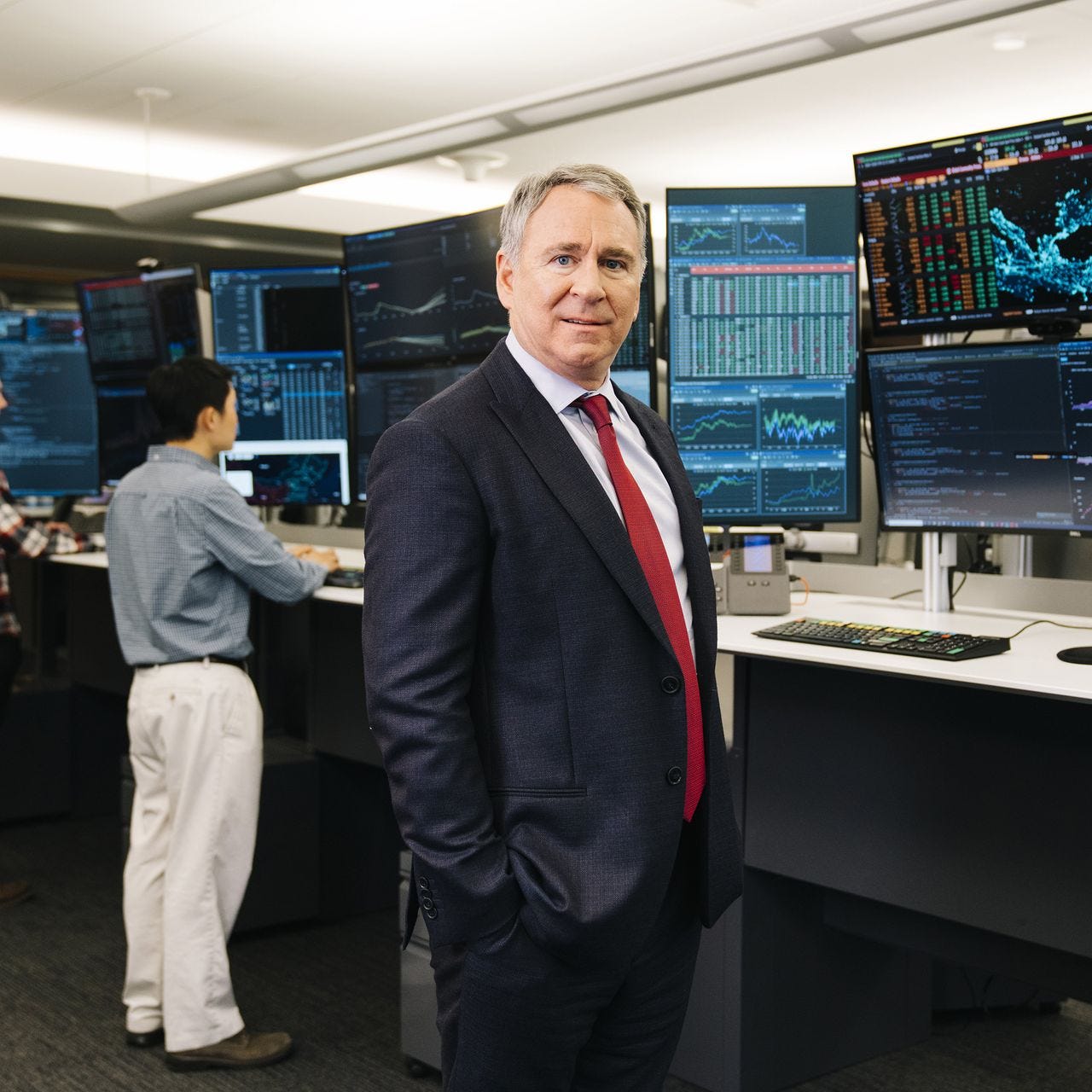
Kenneth Griffin – Top Trader at Citadel
How did he get started? Ted Fishman from Worth Magazine explains:
During his freshman year at Harvard, in 1986, he traded stock options out of his dorm room. In his sophomore year, Griffin launched a convertible-bond arbitrage fund. That year, the 1987 stock-market crash hit, and Griffin struck it rich. When he returned for his senior year, he had $1 million in investors’ money for the same strategy. I spent most of my time at Harvard trading, he says.
How Does Griffin Stay Ahead? The Business Model
Griffin’s greatest talent is not in analysing the market per se. His primary role is as an evaluator of the models his brain trust brings him. Some focus on trades that will be held only a matter of minutes and others on trades that will stay on the books for up to a year and a half.
Citadel has enjoyed outstanding returns the past 10 years, but will face new problems as the firm tries to cope with its mercurial growth.
What Citadel Is and How It Operates
Citadel Investment Group, started in Griffin’s Harvard dorm room in 1987, has become one of the world’s largest hedge funds, accounting for approximately one percent of all trading activity in the United States. The firm operates across multiple strategies simultaneously; equities, fixed income, macro, commodities, and quantitative, with each group running its own models and generating its own returns. Griffin’s role is to evaluate those models, allocate capital across them, and maintain the risk framework that holds everything together.
The multi-strategy approach is what separates Citadel from most hedge funds, which are built around a single thesis or methodology. Griffin built a firm that could generate returns in different market conditions using different tools, rather than concentrating everything in one approach. The result is a business that is far harder to disrupt than a single-strategy fund, because no single market environment can shut down all of its strategies simultaneously.
The 1987 Crash and the Power of Preparation
The detail in the Worth Magazine account that tends to get passed over is the timing of Griffin’s convertible-bond fund. He launched it in his sophomore year. The 1987 market crash hit that same year. His fund was positioned for that environment, and the crash made him wealthy at nineteen years old.
This is not luck in the sense that most people use the word. A nineteen-year-old who had already built a satellite dish on his dormitory roof to receive real-time market data, who had already generated significant returns trading options, and who had already studied the dynamics of convertible bonds was prepared in a way that most adults in the financial industry were not. Preparation that meets a favourable environment looks like luck to observers. It is not. The same principle runs through every serious trading career in the trend following literature: the returns come to those who have done the work before the opportunity appears.
Griffin and Systematic Trading
Citadel runs trend following models within its commodities and macro divisions alongside its discretionary and quantitative strategies. The firm uses systematic models to analyse price patterns across dozens of markets and combines quantitative signals with human insight on large directional macro calls. This is a natural fit for a firm built around evaluating models rather than making individual trading calls.
The connection to the broader trend following world is one of shared infrastructure. The same questions that Richard Dennis and William Eckhardt asked when designing the TurtleTrader system; what is the state of the market, what is its volatility, how much equity is at risk, are the same questions that drive the position sizing and risk management frameworks at firms like Citadel. The tools are more sophisticated. The principles are the same.
Key Facts About Kenneth Griffin and Citadel
- Started trading stock options from his Harvard dorm room in 1986
- Founded Citadel in Chicago in 1990 with $4.6 million in initial capital
- Generated over $60 billion in net gains since inception, one of the best records in hedge fund history
- Citadel accounts for roughly one percent of all US trading activity
- Operates across multiple strategies: equities, fixed income, macro, commodities, quantitative
- Griffin’s primary role is as an evaluator of models rather than a direct market caller
Frequently Asked Questions About Kenneth Griffin and Citadel
How did Kenneth Griffin start trading?
He began trading stock options from his Harvard dormitory during his freshman year in 1986, installing a satellite dish on the roof to receive real-time market data. In his sophomore year he launched a convertible-bond arbitrage fund. When the 1987 stock market crash hit that year, his fund was positioned to benefit and he generated significant returns before the age of twenty.
What is Citadel and how large is it?
Citadel Investment Group is a Chicago-based multi-strategy hedge fund founded by Griffin in 1990 with $4.6 million. It has grown into one of the largest and most profitable hedge funds in history, generating over $60 billion in net gains since inception and accounting for approximately one percent of all US trading activity through its market-making subsidiary Citadel Securities.
Does Citadel use trend following?
Citadel runs trend following and systematic models within its commodities and macro divisions. The firm combines quantitative signals with discretionary macro analysis. Griffin’s approach to risk management and position sizing shares foundational principles with systematic trend following: defining risk in advance, sizing positions based on volatility, and using price signals rather than fundamental predictions as the primary driver of decisions.
Why did Griffin’s fund benefit from the 1987 crash?
His convertible-bond arbitrage fund was designed to exploit pricing inefficiencies in the convertible bond market. The 1987 crash created the kind of dislocations and mispricings that such a strategy is designed to capture. The fund returned seventy percent that year. This outcome was the product of preparation, building and testing a model before the opportunity arrived, not coincidence.
What is Griffin’s role at Citadel today?
His primary role is as an evaluator of the models and strategies his teams develop, rather than as a direct market participant. He allocates capital across Citadel’s multiple strategy groups, sets the overall risk framework, and assesses the models his traders bring to him. Some of those models trade on a timescale of minutes. Others hold positions for up to eighteen months.
Trend Following Systems
Want to learn more and start trading trend following systems? Start here.
